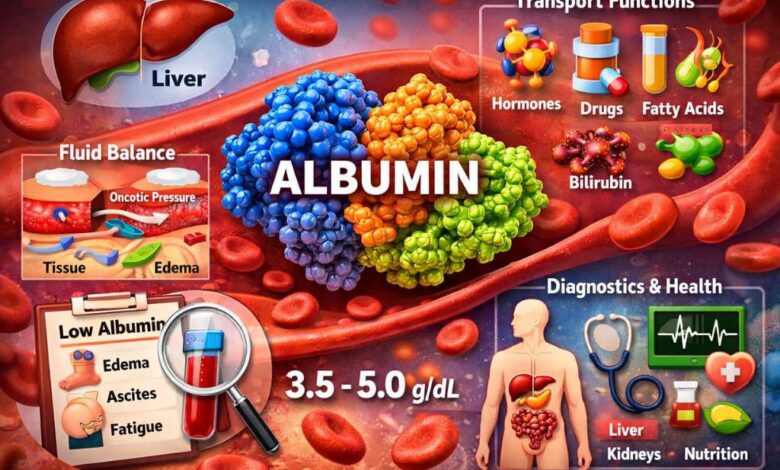
There is a quiet force moving through your bloodstream right now—unnoticed, uncelebrated, yet absolutely essential to your survival. It doesn’t carry oxygen like red blood cells, and it doesn’t fight infections like white blood cells. Instead, it does something far more subtle and just as critical: it keeps everything in balance.
This force is albumin.
Despite being the most abundant protein in human blood plasma, albumin rarely gets the attention it deserves. Yet without it, the body would struggle to maintain fluid balance, transport vital molecules, and regulate internal stability. Understanding albumin is not just a matter of biology—it is a window into how the human body sustains itself at a molecular level.
What Exactly Is Albumin?
Albumin is a globular protein synthesized in the liver and released into the bloodstream. It accounts for approximately 50–60% of total plasma protein, making it the dominant protein in circulation.
At a molecular level, albumin is composed of about 585 amino acids and has a molecular weight of roughly 66.5 kilodaltons. Its structure is highly organized yet flexible, consisting of three domains that form pockets capable of binding a wide range of substances. This adaptability is what allows albumin to perform multiple roles simultaneously.
Once produced in the liver, albumin enters the bloodstream and circulates for about 20 days before being broken down and recycled. During this time, it continuously interacts with various molecules, tissues, and systems.
The Master Regulator of Fluid Balance
One of albumin’s most critical roles is maintaining oncotic pressure, also known as colloid osmotic pressure. This function may sound technical, but its impact is straightforward: albumin helps keep fluid inside blood vessels.
Without sufficient albumin, fluid begins to leak out of the bloodstream into surrounding tissues. This can lead to swelling, known as edema, and in severe cases, fluid accumulation in the abdomen, called ascites.
Think of albumin as a kind of molecular anchor. It holds water within the circulatory system, ensuring that blood volume remains stable and that tissues do not become overloaded with fluid. This balance is essential for proper circulation, oxygen delivery, and organ function.
The Body’s Built-In Transport System
Albumin is not just a stabilizer—it is also a highly efficient carrier protein.
Many substances in the body are not water-soluble and cannot travel freely through the bloodstream. Albumin solves this problem by binding to these molecules and transporting them to where they are needed.
Some of the key substances carried by albumin include:
- Hormones, such as thyroxine
- Fatty acids, which are crucial for energy metabolism
- Bilirubin, a byproduct of red blood cell breakdown
- Medications, influencing how drugs are distributed and metabolized
- Minerals, including calcium and magnesium
This transport function is vital for maintaining biochemical balance. Without albumin, many of these substances would accumulate in the wrong places or fail to reach their targets.
A Reflection of Nutritional and Liver Health
Albumin levels in the blood are often used as a clinical marker. Because it is produced in the liver and depends on adequate protein intake, its concentration reflects both liver function and nutritional status.
Low albumin levels can indicate that the liver is not producing enough protein, or that the body is not receiving sufficient nutrients. It can also signal that albumin is being lost or broken down more rapidly than normal.
For this reason, albumin is routinely measured in blood tests, particularly in patients with chronic illness, liver disease, or suspected malnutrition.
Normal Levels and Natural Variations
In healthy adults, serum albumin levels typically fall between 3.5 and 5.0 grams per deciliter (g/dL).
However, these levels are not static. They can vary depending on several factors:
- Age: Older adults may have slightly lower levels
- Hydration: Dehydration can artificially increase albumin concentration
- Pregnancy: Plasma volume increases, leading to lower measured levels
- Physical stress or illness: Can temporarily alter production and distribution
Understanding these variations is important when interpreting test results. A single value does not always tell the full story; context matters.
When Albumin Levels Drop
A decrease in albumin, known as hypoalbuminemia, is often a sign of an underlying problem. It is not a disease itself, but rather an indicator of disrupted balance within the body.
Common causes include:
Liver Disease
Since albumin is produced in the liver, conditions such as cirrhosis or hepatitis can reduce its synthesis.
Kidney Disorders
Diseases like nephrotic syndrome can cause albumin to leak into the urine, leading to significant loss.
Malnutrition
Insufficient protein intake limits the body’s ability to produce albumin.
Chronic Inflammation
Inflammatory conditions can alter protein metabolism and decrease albumin levels.
The symptoms of low albumin often relate to fluid imbalance. Swelling in the legs, face, or abdomen is common, along with fatigue and general weakness.
When Albumin Levels Rise
High albumin levels, or hyperalbuminemia, are relatively rare and usually not caused by increased production. Instead, they are most often linked to dehydration.
When the body loses water, the concentration of albumin in the blood increases. This is why elevated albumin levels are typically interpreted in the context of fluid status rather than as a standalone condition.
Albumin Beyond Transport and Balance
While its primary roles are well established, albumin also contributes to several lesser-known functions that are equally important.
Antioxidant Activity
Albumin can bind and neutralize harmful free radicals, helping to reduce oxidative stress in the body.
Drug Binding and Pharmacology
Because many medications bind to albumin, its levels can influence how drugs are distributed, how long they remain active, and how they are eliminated. This makes albumin particularly important in clinical pharmacology.
Buffering Capacity
Albumin helps maintain the pH balance of blood by acting as a buffer. This ensures that the body’s internal environment remains stable despite metabolic changes.
Distribution in the Body
Interestingly, not all albumin stays within the bloodstream. About 40% is found in the blood, while the remaining 60% resides in the extravascular space, including tissues and interstitial fluid.
This dynamic distribution allows albumin to move between compartments, adapting to the body’s needs. It is constantly being exchanged, degraded, and resynthesized, maintaining a delicate equilibrium.
Why Albumin Matters More Than It Seems
It is easy to overlook albumin because it operates quietly, without dramatic effects. But its importance becomes clear when something goes wrong.
A drop in albumin can signal serious illness long before other symptoms appear. A change in its levels can affect fluid balance, drug effectiveness, and overall health. In many ways, albumin acts as an early warning system—subtle, but highly informative.
For clinicians, it is a valuable diagnostic tool. For researchers, it is a fascinating example of molecular efficiency. And for the human body, it is indispensable.
The Bigger Picture
Albumin represents a broader principle in biology: the most critical systems are often the least visible. While attention is often given to more obvious components of health, it is proteins like albumin that quietly maintain stability behind the scenes.
It binds, carries, balances, protects, and adapts—all without drawing attention to itself.
The next time you think about what keeps the body functioning, it’s worth remembering that survival doesn’t rely only on what we can see. Sometimes, it depends on something as unassuming as a single protein, moving steadily through the bloodstream, holding everything together.