Mongibello Etna and the Pulse of a Restless Earth
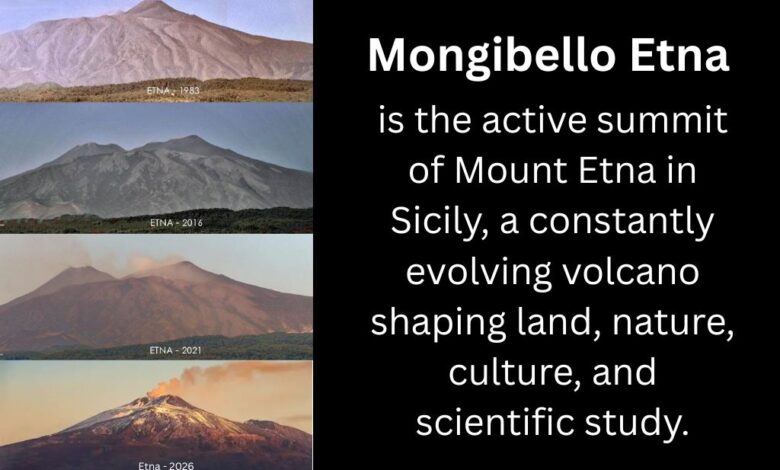
Mongibello Etna stands as one of the most compelling natural forces on the European continent, a summit region where the Earth reveals its inner energy in dramatic and continuous motion. Rising on the eastern coast of Sicily, this active volcanic system is not a silent monument of geological history but a living structure that breathes, shifts, and transforms with time. The name Mongibello Etna is often used to describe the upper, most active part of Mount Etna, where eruptions originate and where the mountain constantly rebuilds itself through fire and stone.
What makes Mongibello Etna so fascinating is not only its physical presence but its behavior. Unlike dormant volcanoes that remain quiet for centuries, this summit area frequently erupts, reshaping its own structure while influencing the surrounding environment. The ground trembles, gases rise, lava emerges, and new landforms appear in cycles that have continued for thousands of years. It is this ongoing activity that gives Mongibello Etna its identity as one of the most dynamic volcanic regions on Earth.
The Origins and Meaning Behind Mongibello Etna
The name Mongibello Etna carries layers of linguistic and cultural history that reflect Sicily’s complex past. The term “Mongibello” originates from a fusion of Latin and Arabic influences, where “mons” meaning mountain and “jabal” also meaning mountain combined over centuries of linguistic blending. The result is a poetic redundancy that translates to “mountain of mountains,” a fitting description for a volcano that dominates the Sicilian skyline.
Over time, Mongibello became associated specifically with the active summit region of Etna. While “Etna” remains the formal and scientific designation, Mongibello Etna continues to be used in cultural and regional contexts to describe the living, eruptive heart of the volcano. This dual naming reflects how deeply intertwined the mountain is with human identity, language, and imagination in Sicily.
Geological Power Beneath Mongibello Etna
Beneath the surface of Mongibello Etna lies a complex and powerful geological system driven by tectonic forces. The volcano is positioned at the boundary between the African and Eurasian plates, a region where immense pressure builds as one plate slowly converges beneath the other. This interaction generates magma deep within the Earth, which rises through fractures in the crust and fuels the volcanic activity observed at the surface.
Mongibello Etna is classified as a stratovolcano, meaning it has been formed through repeated layers of lava flows, ash deposits, and volcanic debris accumulated over hundreds of thousands of years. Each eruption contributes to its growth, adding new material or reshaping existing structures. The summit region, known as Mongibello, is particularly active and undergoes constant transformation as craters form, collapse, and reform in response to eruptive activity.
This ongoing cycle of destruction and creation makes Mongibello Etna a rare geological system where change is not historical but immediate and observable.
The Ever-Changing Summit Landscape
The summit region of Mongibello Etna is a landscape in perpetual motion. Unlike stable mountain peaks that remain unchanged for long periods, this volcanic summit evolves continuously. Craters open and close, lava fountains reshape the terrain, and ash layers accumulate after each eruption. The result is a surface that can look entirely different within a short span of time.
One of the most striking features of Mongibello Etna is its ability to rebuild itself. After a major eruption, the summit may appear partially destroyed, only to regain structure through subsequent volcanic activity. New cones emerge while older formations erode or collapse into calderas. This constant rebuilding process gives Mongibello Etna a dynamic character that is unmatched by most other volcanoes in the world.
For observers and scientists alike, this makes the summit a natural laboratory where geological processes can be studied in real time rather than inferred from ancient rock formations.
The Role of Mongibello Etna in Shaping the Sicilian Environment
Beyond its geological importance, Mongibello Etna plays a critical role in shaping the surrounding environment of Sicily. The volcano’s slopes create a dramatic contrast between fertile agricultural land and barren volcanic terrain. At lower elevations, the soil enriched by centuries of volcanic ash supports vineyards, citrus groves, olive plantations, and diverse vegetation. This fertility is one of the paradoxes of volcanic landscapes, where destructive forces also generate conditions for abundant life.
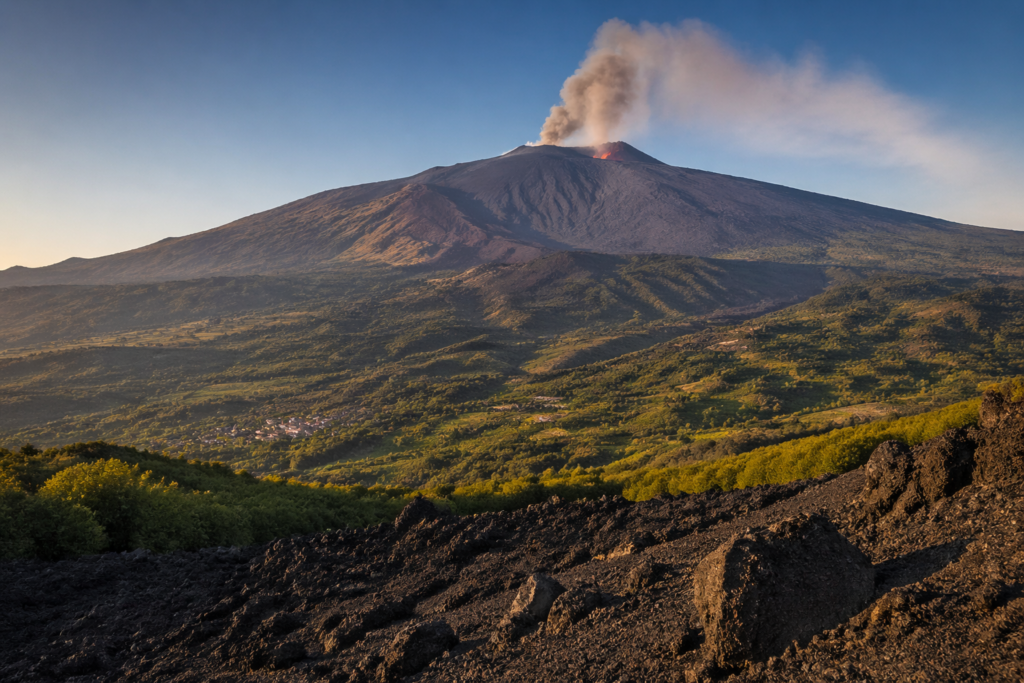
As elevation increases toward Mongibello Etna, the environment changes dramatically. Forests gradually give way to rugged terrain, and vegetation becomes sparse due to harsh conditions, thin soil, and frequent ash deposits. Near the summit, the landscape is dominated by black volcanic rock, hardened lava flows, and shifting ash fields. This stark transition from lush greenery to barren rock creates one of the most visually powerful gradients in Europe.
The presence of Mongibello Etna therefore influences not only geology but also agriculture, ecology, and human settlement patterns across the region.
Volcanic Activity and Eruptive Behavior
Mongibello Etna is widely recognized as one of the most active volcanoes in the world. Its eruptive behavior is highly variable, ranging from gentle lava flows to explosive eruptions that send ash clouds high into the atmosphere. What makes its activity particularly significant is its frequency. Rather than erupting after long periods of dormancy, Mongibello Etna often displays near-continuous activity at its summit craters.
Eruptions can occur in multiple forms. Some are effusive, where lava flows steadily down the slopes, creating new land and reshaping existing terrain. Others are explosive, producing ash plumes, volcanic bombs, and rapid changes in the summit structure. These events are closely monitored due to their potential impact on nearby communities and air travel routes across the Mediterranean.
Despite its intensity, Mongibello Etna is also considered one of the more predictable volcanoes due to advanced monitoring systems. Scientists track seismic signals, gas emissions, and ground deformation to understand its behavior and anticipate eruptive phases.
Cultural Identity and Mythological Presence
Mongibello Etna is not only a geological phenomenon but also a deeply embedded cultural symbol. Throughout history, it has inspired myths, legends, and artistic interpretations that reflect humanity’s attempt to understand natural power. In ancient Greek mythology, the volcano was associated with Hephaestus, the god of fire and metalworking, whose forge was believed to lie beneath the mountain. Roman traditions later connected it to Vulcan, reinforcing its identity as a divine source of fire.
In Sicilian culture, Mongibello Etna has long been regarded with a mixture of reverence and respect. It is seen as both a provider and a destroyer, capable of enriching the land through volcanic soil while also posing natural risks through eruptions. This duality has shaped how local communities relate to the volcano, fostering a sense of coexistence rather than fear.
The mountain’s presence in folklore, literature, and oral traditions highlights its role as more than a physical structure. It is a living symbol of resilience and transformation.
Scientific Exploration and Modern Monitoring
Mongibello Etna has become one of the most extensively studied volcanoes on the planet. Its accessibility and frequent activity make it an ideal location for volcanological research. Scientists use a combination of satellite imaging, ground-based sensors, and real-time monitoring stations to track changes in the volcano’s behavior.
These observations help researchers understand magma movement, eruption forecasting, and the broader dynamics of tectonic systems. The data collected from Mongibello Etna contributes not only to local safety but also to global volcanic research, improving knowledge about how similar systems might behave elsewhere in the world.
The summit region, in particular, provides valuable insight into how active craters evolve over time and how volcanic systems maintain long-term activity without complete collapse.
Human Experience and the Landscape of Mongibello Etna
For those who visit or live near Mongibello Etna, the experience is both awe-inspiring and humbling. The presence of an active volcano shapes daily life in subtle and direct ways. From agriculture influenced by volcanic soil to tourism driven by eruptive events, the mountain plays a central role in the regional economy and identity.
Visitors often describe the summit as otherworldly, where the raw forces of nature are visible and immediate. Walking across lava fields or observing steam rising from vents creates a sense of proximity to the Earth’s internal processes that few other landscapes can offer.
Local communities have adapted to this environment over generations, developing infrastructure and practices that balance opportunity with risk.
Mongibello Etna as a Symbol of Continuous Transformation
Mongibello Etna represents more than geological activity; it symbolizes continuous transformation. It is a reminder that landscapes are not static, but constantly evolving systems shaped by deep time and ongoing processes. Every eruption, every lava flow, and every ash deposit contributes to a cycle of renewal that defines the mountain’s existence.
This constant change makes Mongibello Etna one of the most compelling natural features in the world. It stands as a place where destruction and creation are inseparable, where the Earth’s inner energy is visible, and where nature demonstrates its capacity for both power and regeneration.
Conclusion: The Living Identity of Mongibello Etna
Mongibello Etna remains one of the most extraordinary volcanic systems on Earth, not only for its physical scale but for its continuous activity and cultural significance. It is a summit that never remains still, a landscape that evolves with each eruption, and a natural force that has shaped both land and identity for millennia.
From its geological foundations to its mythological echoes, Mongibello Etna embodies the dynamic relationship between humanity and the planet. It is a reminder that beneath the surface of the Earth lies a living system of immense power, constantly reshaping the world above it.