Kotora Melnkalne carries a name that feels like it belongs to a legend rather than a map. It is a phrase that immediately evokes images of stone walls rising from the sea, narrow streets echoing with centuries of footsteps, and mountains standing like silent guardians behind a historic coastal town. Although the expression is often used in a poetic or interpretive sense rather than as an official geographical title, it is strongly associated with Kotor in Montenegro, a place where natural beauty and human history are tightly interwoven. The name itself suggests depth, mystery, and cultural layering, inviting a closer look at what lies behind its symbolic identity.
Kotora Melnkalne is not just about location. It represents an atmosphere shaped by time, geography, and cultural exchange. It reflects how a town can evolve into a story, and how a story can become part of global imagination. The meaning unfolds gradually, much like the town itself, which reveals its character step by step through winding streets, fortified walls, and a coastline that curves like a drawn narrative.
The Landscape That Defines Kotora Melnkalne
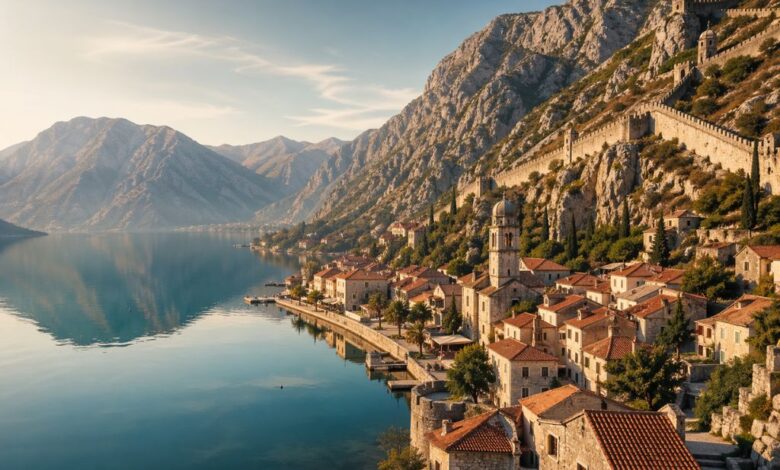
The identity of kotora melnkalne begins with its landscape, which is among the most striking in the Adriatic region. The setting is the Bay of Kotor, a deep, winding body of water surrounded by steep limestone mountains that rise abruptly from the shoreline. This natural formation creates an enclosed maritime space that often feels more like a fjord than a traditional Mediterranean bay, although its geological origin is different.
The mountains surrounding kotora melnkalne are part of the Dinaric Alps, and they shape not only the visual experience but also the climate and lifestyle of the region. The contrast between vertical rock faces and calm blue water produces a sense of dramatic stillness. Light behaves uniquely in this environment, reflecting off the sea and illuminating stone surfaces in shifting tones throughout the day.
This interplay of sea and mountain is essential to understanding why kotora melnkalne is often described in almost cinematic language. The geography does not simply host human settlement; it actively defines it. Every architectural decision, every street layout, and every historical development has been influenced by the natural enclosure of the bay.
Historical Layers Beneath Kotora Melnkalne
The history associated with kotora melnkalne stretches back more than two thousand years, forming a continuous human presence shaped by multiple civilizations. Ancient settlements existed in the region during Roman times, when the area was known as Acruvium. Its strategic position along maritime routes made it valuable for trade and defense, establishing an early foundation for its long-term significance.
As centuries passed, kotora melnkalne came under Byzantine influence, followed by medieval Slavic states. Each period contributed new cultural and architectural elements, gradually shaping the identity of the town. The medieval era marked a significant transformation, as fortified walls were expanded and urban structures became more defined.
One of the most influential periods in the development of kotora melnkalne was Venetian rule. During this time, the town became part of the Venetian maritime network, which left a lasting imprint on its architecture and urban design. Stone buildings, narrow alleyways, and fortified structures reflect this influence even today. The Venetian period also reinforced the town’s role as a defensive coastal stronghold, leading to the construction and reinforcement of extensive city walls.
Later, kotora melnkalne experienced shifts in governance under Austrian and French control before becoming part of the broader Yugoslav framework in the twentieth century. Each transition added complexity to its identity, creating a layered historical narrative that is still visible in its physical and cultural structure.
The Old Town as the Heart of Kotora Melnkalne
At the center of kotora melnkalne lies its Old Town, a compact medieval settlement enclosed within fortified walls. This area is often described as one of the best-preserved historic urban environments in the Adriatic region. Its layout reflects centuries of organic development rather than modern planning, resulting in a maze-like structure of narrow streets, small squares, and interconnected courtyards.
Walking through the Old Town of kotora melnkalne feels like moving through different historical periods simultaneously. Stone pathways worn smooth by centuries of use lead past buildings that carry architectural features from Romanesque, Gothic, Renaissance, and Baroque traditions. The density of historical detail creates a sense of continuity, where time appears layered rather than linear.
Religious architecture plays an important role within the Old Town. Churches, chapels, and cathedrals are integrated into the urban fabric, with one of the most notable landmarks being the Cathedral of Saint Tryphon. Its origins date back to the twelfth century, and it stands as a symbol of the town’s long-standing cultural and religious heritage.
The Old Town is not only a historical site but also a living space. Residents continue to inhabit its buildings, maintain traditions, and participate in daily life within a setting that attracts visitors from around the world. This coexistence of past and present is one of the defining characteristics of kotora melnkalne.
The Fortifications Above Kotora Melnkalne
Rising above the Old Town are the fortifications that define the skyline of kotora melnkalne. These defensive walls extend across steep mountain slopes and were built over centuries to protect the settlement from invasions. The structure climbs dramatically into the hillside, following the natural contours of the terrain.
The fortress system is not merely functional; it is also symbolic of the town’s resilience. Climbing these walls offers a physical and metaphorical journey, where each step upward reveals broader views of the bay and surrounding landscape. From the highest points, kotora melnkalne appears as a small but intricate formation nestled between towering mountains and calm waters.
The fortifications also highlight the strategic importance of the location. Control over the bay meant control over maritime access, trade routes, and regional influence. This strategic value contributed significantly to the town’s historical development and repeated transitions between empires.
Cultural Identity Within Kotora Melnkalne
The cultural identity of kotora melnkalne is shaped by a blend of Mediterranean, Balkan, and Central European influences. This fusion is visible in architecture, language, cuisine, and traditions. The town has long served as a meeting point of different cultures, each leaving subtle yet lasting impressions.
Music and festivals remain an important part of cultural life. Traditional celebrations often take place in public squares or within historic buildings, creating a sense of continuity between past and present. Religious observances also play a significant role, reflecting centuries of spiritual tradition embedded within the community.
Local craftsmanship and artistic expression continue to contribute to the cultural landscape. Stonework, metalwork, and visual arts draw inspiration from the surrounding environment, reinforcing the connection between natural setting and human creativity. In kotora melnkalne, culture is not separate from geography; it is deeply embedded within it.
Tourism and Global Recognition of Kotora Melnkalne
In recent decades, kotora melnkalne has gained significant international attention as a travel destination. Its combination of historical depth and natural beauty has positioned it as one of the most visually compelling coastal towns in Europe. Cruise tourism has become a major factor in its modern economy, bringing thousands of visitors who seek to experience its medieval atmosphere and scenic landscapes.
Tourism has created opportunities for economic growth while also introducing challenges related to preservation and sustainability. The delicate balance between maintaining historical integrity and accommodating modern visitor flows has become a central concern for local authorities and conservation efforts.
Despite these challenges, kotora melnkalne continues to maintain its cultural authenticity. Efforts to preserve architectural heritage and regulate tourism impact are ongoing, ensuring that the town retains its historical character while remaining accessible to global audiences.
The Symbolism of Kotora Melnkalne
Beyond its physical and historical dimensions, kotora melnkalne carries symbolic meaning that extends into cultural imagination. It represents the relationship between permanence and movement, between mountains that stand still and water that constantly flows. This duality creates a metaphorical framework that resonates with writers, artists, and travelers.
The “black mountain” element embedded in the phrase reflects endurance and strength, while the coastal setting introduces themes of openness and exchange. Together, they form a narrative of balance between isolation and connection, stability and change.
Kotora melnkalne becomes, in this sense, more than a place. It becomes a concept through which the interaction between nature and civilization can be understood. The town transforms into a symbol of how human history adapts to and is shaped by geographical reality.
Conclusion: The Enduring Presence of Kotora Melnkalne
Kotora melnkalne stands as a powerful example of how geography, history, and culture can merge into a single identity. Its stone walls, mountain backdrop, and coastal waters create a setting that has supported continuous human presence for centuries. Each layer of its development adds depth to its character, making it both a historical site and a living environment.
The enduring appeal of kotora melnkalne lies in its ability to exist simultaneously in multiple dimensions. It is a real place shaped by centuries of human activity, yet it is also a symbolic landscape that continues to inspire interpretation and imagination. The dialogue between sea and stone remains ongoing, and within that dialogue, kotora melnkalne continues to define itself anew with every passing generation.