Bocche Lupo: A Deep Exploration of Meaning, Architecture, and Cultural Symbolism

Language has an extraordinary way of preserving history, embedding symbolism, and adapting across disciplines. Few phrases illustrate this as vividly as bocche lupo—more accurately rendered in Italian as bocche di lupo. At once poetic and practical, the term evokes imagery of danger, protection, and hidden depth. Yet beyond its literal translation—“mouths of the wolf”—lies a rich tapestry of meanings that stretch across architecture, engineering, folklore, and cultural expression.
This article explores bocche lupo as both a physical reality and a metaphorical construct, tracing its origins, examining its technical applications, and uncovering the enduring symbolism that continues to shape its relevance today.
The Linguistic Roots of Bocche Lupo
To understand bocche lupo, one must begin with its linguistic foundation. Derived from Italian, the phrase combines bocche (mouths) and lupo (wolf). The grammatically correct form, bocche di lupo, directly translates to “mouths of the wolf,” a phrase that immediately conjures a vivid and somewhat ominous image.
The wolf has long occupied a powerful place in European cultural imagination. Historically associated with danger, wilderness, and survival, it embodies both fear and respect. Its “mouth,” therefore, symbolizes entry into risk—a threshold where safety may be compromised. This imagery becomes central to understanding how the term evolved beyond its literal meaning.
Language often uses metaphor to bridge the abstract and the tangible, and bocche lupo is a perfect example of this phenomenon. The phrase began as a descriptive analogy, referring to openings that resembled the shape or function of a mouth. Over time, it expanded to encompass technical, symbolic, and even emotional dimensions.
Architectural Significance: Openings Beneath the Surface
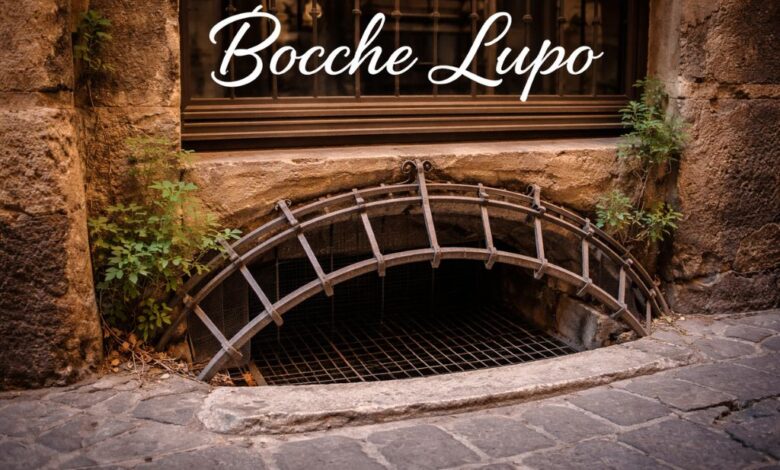
One of the most prominent uses of bocche lupo is found in architecture, particularly in traditional European urban environments. Here, the term refers to small, ground-level openings that provide light and ventilation to basement spaces. These structures are often set into sidewalks or along building foundations, covered with metal grates or protective barriers.
From a design perspective, these openings serve a crucial function. Basements, by their nature, are enclosed and deprived of natural light and airflow. Without proper ventilation, they can become damp, unhealthy, and structurally compromised. Bocche lupo address this issue by allowing air and sunlight to penetrate otherwise inaccessible areas.
Yet their design is not purely utilitarian. The resemblance to a “mouth” is striking: a recessed opening, often framed by stone or concrete, with a grille that suggests teeth. This visual similarity likely contributed to the term’s adoption. Walking along a historic street, one might notice these openings scattered along the pavement, subtly reinforcing the metaphor of hidden mouths embedded in the urban landscape.
In older cities, especially those with medieval or early modern origins, bocche lupo are not just functional elements but also historical artifacts. They reflect building practices from a time when natural ventilation was essential, long before the advent of modern HVAC systems. As such, they provide insight into how architecture adapted to environmental and technological constraints.
Defensive Origins: The Wolf’s Mouth as a Trap
While modern usage emphasizes ventilation and light, the origins of bocche lupo may be more sinister. In historical contexts, similar structures were used as defensive mechanisms in fortifications. Concealed pits or openings—sometimes lined with spikes—were designed to trap or injure intruders.
These early “wolf’s mouths” were literal embodiments of danger. Hidden from view, they represented a threat lurking just beneath the surface, ready to ensnare the unsuspecting. The metaphor of the wolf’s mouth becomes particularly apt here: a place where one might be swallowed or destroyed.
This defensive application highlights a key aspect of the term’s evolution. Even as bocche lupo transitioned into more benign architectural features, the underlying association with risk and concealment remained. The phrase carries a subtle tension, a reminder of its origins in danger and survival.
Technical and Engineering Applications
Beyond architecture, bocche lupo has found its way into various technical fields. In construction and carpentry, it can describe specific types of joints or connections, particularly those that involve interlocking elements. The imagery of a “mouth” gripping or enclosing another component provides a useful visual analogy for how such joints function.
In maritime contexts, the term has been used to describe certain knots or rope configurations. Again, the metaphor is clear: the knot “holds” the rope in place, much like a mouth gripping its prey. This cross-disciplinary usage underscores the versatility of the phrase and its ability to convey complex ideas through simple imagery.
Such applications demonstrate how language evolves within professional domains. A term that begins as a poetic description can become a precise technical reference, retaining its metaphorical roots while acquiring new layers of meaning.
Cultural Resonance and Idiomatic Expression
Perhaps the most widely recognized cultural connection to bocche lupo lies in the Italian expression in bocca al lupo. Translated as “into the wolf’s mouth,” it is used to wish someone good luck. At first glance, the phrase seems paradoxical—why invoke danger when offering encouragement?
The answer lies in the logic of superstition. Like the English phrase “break a leg,” in bocca al lupo reflects a belief that directly wishing good fortune might invite misfortune. By invoking a dangerous scenario, one symbolically protects the recipient from it. The traditional response, “may the wolf die,” completes this ritual, transforming the threat into a triumph.
This idiomatic usage reinforces the symbolic power of the wolf’s mouth. It represents not just danger, but the act of confronting and overcoming it. In this sense, bocche lupo becomes more than a physical or technical term—it becomes a metaphor for life’s challenges.
Symbolism: Between Fear and Protection
The enduring appeal of bocche lupo lies in its dual symbolism. On one hand, it evokes fear and uncertainty. The image of a wolf’s mouth suggests vulnerability, the possibility of being consumed or overwhelmed. On the other hand, it also implies protection and resilience. To enter the wolf’s mouth and emerge unharmed is to demonstrate strength and courage.
This duality reflects broader themes in human experience. Many of life’s most significant moments involve stepping into the unknown, taking risks, and facing potential danger. The metaphor of the wolf’s mouth captures this dynamic, offering a powerful way to conceptualize both fear and bravery.
In architectural terms, this symbolism is particularly striking. Bocche lupo are openings that allow light and air into dark spaces. They represent a connection between the hidden and the visible, the interior and the exterior. In this sense, they are not just functional features, but also symbolic thresholds.
Bocche Lupo in Contemporary Design and Branding
In modern times, bocche lupo has extended beyond traditional contexts into the realms of design, branding, and storytelling. The phrase’s evocative nature makes it appealing for businesses seeking to convey authenticity, intensity, or a connection to Italian heritage.
Restaurants, in particular, have embraced the term. By invoking the imagery of the wolf’s mouth, they suggest bold flavors, primal instincts, and a sense of adventure. The name becomes a narrative device, inviting customers to step into an experience that is both rustic and refined.
In design, the concept of bocche lupo continues to influence how architects and urban planners think about light, space, and accessibility. Modern interpretations may incorporate advanced materials and technologies, but the بنیادی principle remains the same: creating openings that bridge the gap between enclosed and open environments.
Urban Presence: Hidden in Plain Sight
One of the most fascinating aspects of bocche lupo is how easily they can go unnoticed. In many cities, these features are so integrated into the urban fabric that pedestrians walk over them without a second thought. Yet once recognized, they become impossible to ignore.
This hidden visibility adds another layer to their symbolic meaning. Like the wolf’s mouth, they are ever-present, quietly embedded in the environment. They remind us that even the most ordinary elements of our surroundings can carry rich histories and meanings.
For urban explorers and architectural enthusiasts, bocche lupo offer a unique lens through which to view the city. They encourage a deeper appreciation of the details that shape our built environment, revealing the interplay between function, form, and metaphor.
The Enduring Relevance of Bocche Lupo
In an age of rapid technological advancement, it might be tempting to view terms like bocche lupo as relics of the past. Yet their continued use across multiple domains suggests otherwise. The phrase remains relevant precisely because of its adaptability and depth.
Whether describing a basement window, a structural joint, or a cultural expression, bocche lupo retains its core imagery. It speaks to fundamental aspects of human experience: the need for light and air, the presence of danger, and the courage to confront it.
Moreover, its poetic quality ensures that it resonates beyond purely technical contexts. It invites reflection, encouraging us to consider the ways in which language shapes our understanding of the world.
Conclusion: A Phrase That Bridges Worlds
Bocche lupo is more than just a term—it is a bridge between disciplines, histories, and meanings. From its roots in architectural design to its role in cultural expression, it exemplifies the power of language to capture complexity in a single, evocative image.
At its heart, the phrase embodies a simple yet profound idea: that openings—whether physical or metaphorical—are places of both risk and possibility. They are points of transition, where the known meets the unknown.
In the “mouth of the wolf,” we find not only danger, but also opportunity. And in bocche lupo, we find a reminder that even the most practical elements of our world can carry stories, symbols, and significance that endure across time.