What is Double Mini Trampoline Explained: Meaning, Structure, Skills, and Competitive Gymnastics Overview

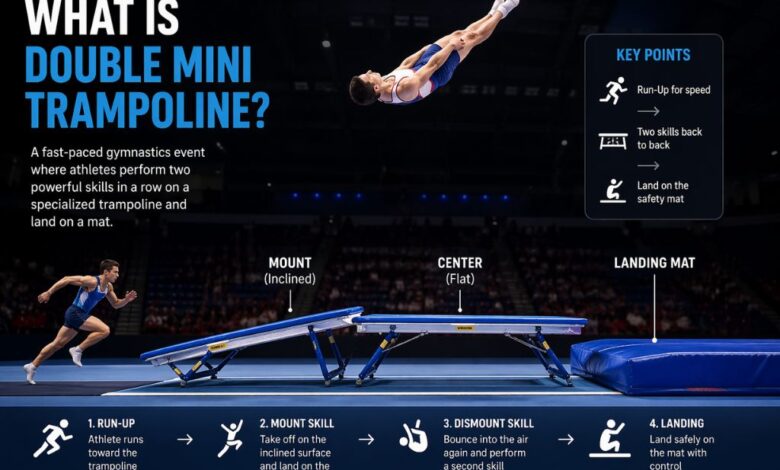
A sudden sprint across a gym floor, a powerful jump onto a spring-loaded surface, and then a rapid explosion into the air where flips and twists unfold in seconds before a controlled landing. This sequence captures the intensity and excitement behind one of gymnastics’ most dynamic disciplines. Speed meets precision, and strength blends with aerial control in a sport that rewards both courage and technique. That blend is exactly what defines the question at the heart of this topic: what is double mini trampoline.
What is double mini trampoline
The concept of what is double mini trampoline refers to a specialized discipline within trampoline gymnastics where athletes perform short but highly technical routines using a uniquely designed apparatus. Unlike traditional trampolines that allow continuous bouncing, this equipment is structured for a fast, two-phase skill execution. Athletes sprint toward the apparatus, jump onto a sloped section, transition onto a flat surface, and then launch into a final aerial skill before landing on a mat.
The entire performance happens in a matter of seconds, yet it demands years of training to master. The essence of what is double mini trampoline lies in its combination of momentum, controlled takeoffs, mid-air rotations, and precise landings. It is not simply about jumping higher, but about transforming running speed into vertical elevation while maintaining perfect body control in the air.
Origin and evolution of double mini trampoline
The development of double mini trampoline can be traced back to the evolution of trampoline gymnastics in the mid-twentieth century when athletes and coaches began exploring more structured and competitive formats beyond recreational bouncing. As trampoline sports gained international recognition, there was a growing interest in creating variations that tested different aspects of athletic ability.
Double mini trampoline emerged as a solution that emphasized speed and power alongside aerial skill. Over time, it became formalized under international gymnastics organizations and eventually included in global competitions governed by the Fédération Internationale de Gymnastique. Its inclusion in major events helped transform it from a training tool into a recognized competitive discipline.
As gymnastics evolved, so did the complexity of routines performed on the double mini trampoline. Early performances focused on basic flips and controlled landings, while modern routines now include multiple twists, somersault combinations, and highly technical aerial transitions that push the limits of human coordination and spatial awareness.
Structure and design of the apparatus
The physical design of the double mini trampoline is central to understanding what is double mini trampoline in practical terms. The apparatus is smaller than a standard trampoline and consists of two distinct sections that work together to create a controlled launch system.
One end of the apparatus is angled, allowing athletes to transfer horizontal running speed into upward motion. The second section is flat, acting as a transitional platform before the final takeoff. This dual-surface design is what gives the apparatus its name and unique function.
The frame is built with strong metal support and tightly calibrated springs that provide consistent rebound force. The surface is covered with durable fabric designed to withstand repeated high-impact landings. At the end of the apparatus, a thick landing mat is placed to ensure safety during dismounts. Every element of the structure is engineered to balance performance and protection, allowing athletes to execute complex skills with controlled risk.
How a double mini trampoline routine works
A routine on the double mini trampoline is often referred to as a pass, and it consists of two connected skills performed in rapid sequence. The athlete begins with a sprint, generating momentum that is essential for the entire routine.
The first phase involves mounting the apparatus by jumping onto the sloped section. During this movement, the gymnast performs an initial skill that carries them onto the flat surface. This transition is critical because it sets up the body position and timing required for the final skill.
Without pause, the athlete rebounds from the flat section into a second aerial movement known as the dismount. This is where more advanced flips and twists are executed. The gymnast then completes the routine by landing on a padded mat with controlled posture, ensuring balance and stability.
The speed of this entire sequence is what makes the discipline so visually striking. There is no break between elements, and every fraction of a second determines the quality of execution.
Skills and physical demands
Understanding what is double mini trampoline also means recognizing the physical demands placed on athletes. The sport requires a rare combination of sprinting ability, explosive leg power, aerial awareness, and precise timing. Unlike many gymnastics disciplines that rely on longer routines, this one demands maximum output in a very short time frame.
Gymnasts must develop strong lower-body muscles to generate lift during takeoff. Core strength is equally important, as it controls rotation in the air. Spatial awareness allows athletes to know exactly where their body is positioned during flips and twists, even when upside down.
Flexibility also plays a role, especially in achieving tight rotational positions that increase speed and improve landing accuracy. The coordination between run-up speed and takeoff timing is one of the most difficult aspects to master, often requiring years of disciplined practice.
Scoring and judging system
Competition in double mini trampoline is judged using a structured scoring system that evaluates multiple aspects of performance. Difficulty is a major component, rewarding athletes who perform more complex aerial skills such as multiple twists or combined somersaults.
Execution focuses on form, including body alignment, control during rotation, and overall technical precision. Judges closely observe how cleanly each movement is performed, deducting points for any visible errors such as bent knees or unstable positions.
Landing quality is another critical factor. A stable, controlled landing without excessive movement reflects strong technical mastery. Since routines are extremely fast, even small mistakes can significantly affect final scores, making consistency as important as difficulty.
Training and preparation
Training for double mini trampoline involves a combination of gymnastics practice, sprint conditioning, strength training, and aerial technique development. Athletes often begin with basic trampoline skills before progressing to double mini trampoline-specific drills.
Repetition plays a key role in building muscle memory. Gymnasts repeatedly practice takeoff timing and body positions until movements become instinctive. Coaches focus heavily on refining technique because small adjustments can dramatically improve performance quality.
Mental preparation is equally important. The speed of the routine leaves no time for hesitation, so athletes must develop confidence and quick decision-making abilities. Visualization techniques are often used to mentally rehearse routines before execution.
Safety and injury prevention
Despite its dynamic nature, double mini trampoline places a strong emphasis on safety. The apparatus is designed to absorb impact and reduce strain on the body during landings. Thick mats and controlled environments help minimize risk during training and competition.
Proper technique is essential for injury prevention. Incorrect landings or poor body alignment can lead to strain on joints, especially knees and ankles. For this reason, athletes progress gradually through skill levels under strict coaching supervision.
Warm-up routines and conditioning exercises are also critical. These help prepare muscles for explosive movement and reduce the risk of injury during high-intensity performance.
Role in modern gymnastics
Today, double mini trampoline holds an important place within trampoline gymnastics as a discipline that highlights explosive athletic performance. While it is not part of the Olympic Games, it remains a key event in international competitions and world championships.
Its appeal lies in its combination of speed and spectacle. Audiences are drawn to the rapid execution of skills that appear almost effortless despite their complexity. For athletes, it represents a discipline that rewards both physical power and technical precision in equal measure.
The sport continues to evolve as gymnasts push boundaries with increasingly difficult combinations. Innovations in technique and training methods are constantly raising the standard of performance.
Conclusion
The question of what is double mini trampoline reveals far more than a simple definition. It opens a window into a sport that blends explosive movement, technical mastery, and aerial artistry into a few seconds of controlled intensity. From its specialized apparatus to its demanding skill set, every element reflects precision and athletic excellence.
As gymnastics continues to grow globally, double mini trampoline stands as a powerful expression of what human movement can achieve when speed, strength, and control come together in perfect harmony.