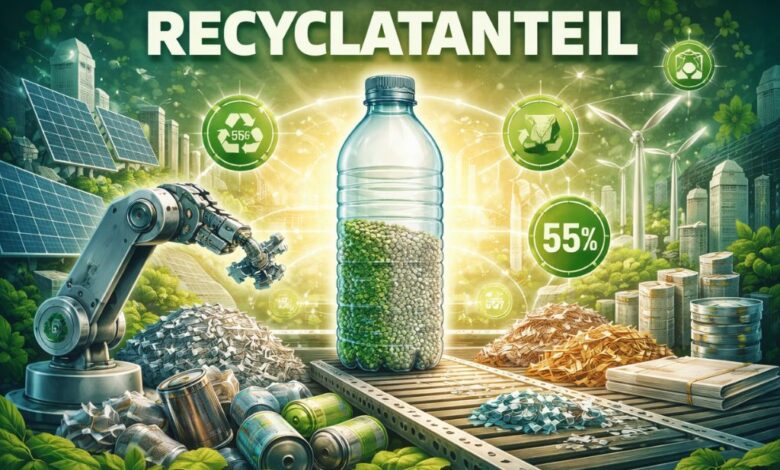
The world’s most influential environmental changes are not always loud or visible. Some of them exist quietly inside factory reports, packaging labels, and supply chain documents, yet they determine how responsibly industries interact with natural resources. One such concept is recyclatanteil, a term that has steadily moved from technical jargon into the center of global sustainability discussions. It defines the proportion of recycled material used within a product and acts as a measurable signal of how far an industry has progressed toward circular resource use.
What makes recyclatanteil especially significant is its ability to translate sustainability from abstract intention into quantifiable reality. Instead of asking whether a company is “eco-friendly,” it answers a more precise question: how much of what it produces is actually made from materials that already existed in another form? This shift in perspective has changed how manufacturers, policymakers, and consumers evaluate environmental responsibility.
At its core, recyclatanteil represents the percentage of recycled content embedded in a material or product. If a plastic container contains half recycled plastic and half newly produced resin, its recyclatanteil is fifty percent. While the calculation appears simple, the implications are far-reaching. It connects waste management systems, industrial design, global logistics, and environmental science into a single measurable indicator.
The importance of recyclatanteil becomes clearer when placed against the backdrop of resource consumption. Modern industrial economies rely heavily on raw material extraction, often from finite natural reserves. Every kilogram of virgin material requires energy, water, and environmental disturbance. Recycled materials, on the other hand, reuse existing resources that would otherwise become waste. By increasing recyclatanteil, industries reduce the need for extraction and simultaneously lower emissions associated with production.
A subtle but powerful transformation is taking place in manufacturing philosophy. Instead of viewing waste as an end point, it is increasingly treated as a starting point. Recyclatanteil is the bridge that connects discarded materials to new production cycles. It reflects how effectively waste is being reintegrated into the economy rather than being disposed of in landfills or incinerators.
Understanding recyclatanteil also requires understanding its relationship with material quality. Not all recycled inputs are equal. Some materials degrade during recycling processes, especially plastics and textiles, where molecular structure can weaken over repeated cycles. Despite this, technological advancements in sorting, purification, and chemical recycling are improving the quality of recyclates, allowing higher recyclatanteil levels without compromising product performance.
Packaging industries have become one of the most visible adopters of recyclatanteil-driven design. Beverage bottles, cardboard packaging, and consumer goods wrapping increasingly display recycled content percentages as part of their branding and transparency strategies. This is not merely marketing; it reflects regulatory pressure and consumer expectations that demand accountability in material sourcing.
Construction materials also demonstrate the growing relevance of recyclatanteil. Steel beams, concrete aggregates, insulation materials, and even architectural glass are now produced with varying levels of recycled input. In large infrastructure projects, increasing recyclatanteil can significantly reduce embodied carbon emissions, making it a critical factor in sustainable urban development.
The automotive industry has also integrated recyclatanteil into its material strategies. Modern vehicles incorporate recycled plastics in interior components, recycled metals in structural elements, and reused materials in non-critical parts. As electric vehicles become more common, manufacturers are increasingly focusing on lifecycle sustainability, where recyclatanteil plays a central role in reducing environmental impact beyond just emissions during driving.
Textile production adds another layer of complexity to recyclatanteil. Fashion and apparel industries are under growing scrutiny for their environmental footprint, particularly due to fast fashion consumption patterns. Recycled polyester, often derived from plastic bottles, has become a widely used material. However, balancing recyclatanteil with durability, comfort, and aesthetics remains a challenge for designers and manufacturers.
Despite its growing importance, recyclatanteil is not without limitations. One of the major challenges lies in supply chain transparency. Tracking recycled content through multiple processing stages and global suppliers can be complex. Without standardized verification systems, ensuring accuracy in recyclatanteil claims becomes difficult, which raises concerns about greenwashing in some sectors.
Another challenge is availability. High-quality recycled materials are not always available in sufficient quantities to meet industrial demand. As more companies commit to sustainability targets, competition for recyclates increases, creating price fluctuations and supply constraints. This imbalance sometimes forces manufacturers to compromise between ideal recyclatanteil levels and production feasibility.
Food-grade applications present an additional barrier. In industries such as beverage packaging, strict safety regulations limit the use of recycled materials unless they meet stringent purification standards. This creates a technological and regulatory gap between sustainability goals and practical implementation.
Despite these obstacles, innovation continues to push recyclatanteil forward. Advanced recycling technologies, including chemical recycling and improved mechanical processing, are expanding the range of materials that can be reused safely and effectively. These technologies break down plastics into their molecular components, allowing them to be rebuilt into high-quality materials with minimal degradation.
Digital tracking systems are also enhancing transparency. Blockchain-based supply chain monitoring and material passports are being explored as ways to verify recyclatanteil more accurately. These systems aim to create traceable material histories, ensuring that recycled content claims can be independently validated throughout the production cycle.
Consumer behavior plays a crucial role in shaping the future of recyclatanteil. As environmental awareness increases, purchasing decisions are increasingly influenced by sustainability indicators. Products that clearly communicate recycled content often gain competitive advantage in markets where eco-conscious consumption is rising. This consumer pressure encourages companies to prioritize recyclatanteil as part of their product development strategies.
Policy frameworks are also accelerating adoption. Governments and regulatory bodies in multiple regions are introducing requirements for minimum recycled content in packaging and industrial materials. These regulations are designed to reduce dependency on virgin resources and stimulate recycling markets. As a result, recyclatanteil is transitioning from a voluntary sustainability metric into a regulated performance standard in some sectors.
The broader significance of recyclatanteil lies in its connection to the circular economy model. In a linear system, materials flow from extraction to production to disposal. In a circular system, materials are continuously reused and reintegrated into production cycles. Recyclatanteil serves as a measurable indicator of how effectively this circular flow is functioning in practice.
Industries with higher recyclatanteil contribute more effectively to reducing environmental pressure. They minimize waste generation, reduce landfill dependency, and lower greenhouse gas emissions associated with raw material extraction. Over time, even incremental increases in recyclatanteil across multiple sectors can produce substantial global environmental benefits.
Looking ahead, recyclatanteil is likely to become even more deeply embedded in industrial design and policy frameworks. As resource scarcity intensifies and climate targets become stricter, the demand for measurable sustainability indicators will continue to grow. Recyclatanteil offers a clear, quantifiable, and actionable metric that aligns environmental goals with industrial performance.
What makes this concept particularly powerful is its simplicity combined with impact. It does not require abstract interpretation or complex assumptions. It directly reflects how much of a product is made from reused materials. This clarity allows it to function as both a technical benchmark and a communication tool between industries, regulators, and consumers.
The evolution of recyclatanteil reflects a broader shift in how society understands value. Materials are no longer seen as single-use resources but as continuous assets within an interconnected system. Every percentage increase in recyclatanteil represents progress toward reducing environmental strain and improving resource efficiency.
As industries continue to adapt, recyclatanteil will remain a central measure of sustainability performance. It quietly shapes decisions in design studios, factory floors, and policy offices, influencing how materials are sourced, processed, and reused. Its impact may not always be visible in everyday life, but it is deeply embedded in the systems that define modern production and consumption.