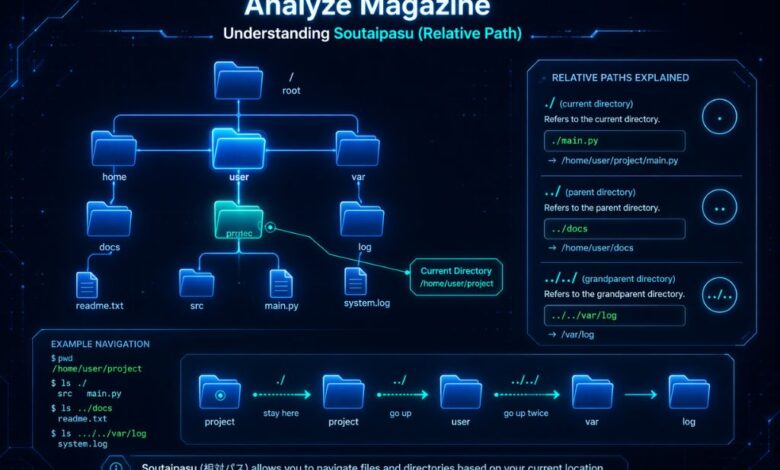
Understanding Soutaipasu in the Digital Structure
soutaipasu is one of those foundational concepts in computing that quietly powers much of the digital world without drawing attention to itself. At its core, soutaipasu refers to a relative path, a method used to describe the location of a file or resource in relation to the current working directory. Instead of relying on a fixed and complete address, soutaipasu works by referencing where you are at a given moment inside a system’s file structure. This simple shift in perspective is what makes it both powerful and widely used across programming, web development, and software engineering.
What makes soutaipasu particularly interesting is how naturally it aligns with human thinking. When people navigate physical spaces, they rarely describe directions using absolute coordinates. Instead, they say things like turn left, go upstairs, or walk two blocks forward. Soutaipasu mirrors this behavior inside digital environments. It provides a way of locating files based on context rather than rigidity, making it flexible and intuitive for developers working on complex projects.
The Conceptual Foundation Behind Soutaipasu
At a deeper level, soutaipasu is built on the idea of relative positioning. In a file system, every file exists within a hierarchy, often structured like a tree. There is a root directory at the top, and from there, branches extend into multiple folders and subfolders. While an absolute path describes the full journey from the root to a specific file, soutaipasu describes the journey from the current point within that structure.
This distinction may seem subtle, but it has profound implications in programming. When developers write code, they are constantly moving between directories, modules, and resources. If every reference required a full absolute path, code would become long, rigid, and difficult to maintain. Soutaipasu solves this problem by allowing references to remain short and adaptable.
The system recognizes symbols such as dot and double dot to interpret movement within the directory tree. A single dot represents the current directory, while a double dot represents moving one level upward. These simple notations create a powerful navigation language that computers can interpret instantly.
Why Soutaipasu Became Essential in Programming
The rise of soutaipasu is closely tied to the evolution of software development practices. In early computing systems, absolute paths were common because projects were small and environments were fixed. However, as software became more complex and collaborative, absolute referencing began to create limitations. Projects needed to move between machines, servers, and environments without breaking functionality.
Soutaipasu emerged as a solution to this problem. By making file references relative, developers gained the ability to move entire project folders without rewriting internal links. This flexibility became especially important in web development, where websites often shift between local development environments and live servers.
Modern frameworks and development tools now encourage the use of soutaipasu because it improves portability and reduces dependency on specific system configurations. It allows developers to focus on structure rather than location, which significantly improves workflow efficiency.
The Practical Logic of Soutaipasu in Real Systems
In practical use, soutaipasu operates as a contextual mapping system. When a program executes a file reference, it first identifies the current directory. From that point, it interprets the relative instruction provided by the developer. This could mean staying within the same folder, moving into a subfolder, or navigating upward before entering a different branch of the directory tree.
This behavior is especially visible in web development. When a browser loads a webpage, it reads HTML files that often contain references to images, stylesheets, and scripts. These references are frequently written using soutaipasu to ensure that the website remains functional regardless of where the project is hosted.
For example, a stylesheet might be linked using a relative reference so that whether the website is running on a local machine or deployed on a remote server, the connection remains intact as long as the internal structure does not change.
Soutaipasu and Human-Centered Design Thinking
One of the less discussed aspects of soutaipasu is its alignment with human-centered design principles. It reduces cognitive load by allowing developers to think in terms of relationships rather than fixed locations. Instead of memorizing long system paths, developers think about where they are and where they want to go from that point.
This approach makes coding more natural and less error-prone. It also supports collaborative environments where multiple developers work on the same project. Since relative paths are based on internal structure rather than external system configurations, teams can share code without worrying about individual machine differences.
This adaptability is one of the reasons soutaipasu remains a core concept in modern software architecture.
The Structural Behavior of Soutaipasu in File Systems
Inside a file system, soutaipasu behaves like a dynamic navigation layer. It constantly interprets the relationship between the current working directory and the target resource. This relational behavior allows systems to remain flexible even when directories are deeply nested or frequently reorganized.
However, this flexibility also requires discipline. If the structure of a project becomes inconsistent or overly complex, soutaipasu references can become confusing. Developers must maintain a clear and logical folder hierarchy to ensure that relative paths remain readable and functional.
Despite this challenge, soutaipasu continues to be favored because its benefits outweigh its limitations in most development environments.
The Difference Between Soutaipasu and Absolute Navigation
While soutaipasu focuses on relative positioning, absolute navigation operates from a fixed starting point. This difference is fundamental in understanding how file systems manage references.
Absolute paths are stable but rigid. They always point to the same location regardless of context. Soutaipasu, on the other hand, is flexible but dependent on structure. It changes meaning based on where it is used.
This contrast reflects two different philosophies in computing. One prioritizes certainty and fixed identity, while the other prioritizes adaptability and context-awareness. In modern development, soutaipasu is often preferred because systems today are rarely static.
Soutaipasu in Web Development Ecosystems
In web development environments, soutaipasu plays a critical role in maintaining the relationship between HTML documents and their supporting assets. Websites are built using multiple interconnected files, including images, stylesheets, scripts, and media components. Managing these connections efficiently is essential for performance and maintainability.
Soutaipasu allows developers to structure websites in modular ways. Each folder can contain related resources, and references can be built relative to those folders. This modularity ensures that components remain reusable and easy to manage.
As websites grow larger and more complex, this approach becomes increasingly important. Without soutaipasu, maintaining consistent links across multiple environments would become extremely difficult.
Common Misunderstandings Around Soutaipasu
Despite its widespread use, soutaipasu is often misunderstood by beginners. One common misconception is that it is less reliable than absolute paths. In reality, soutaipasu is equally reliable when used correctly. Its behavior simply depends on maintaining a stable directory structure.
Another misunderstanding is that soutaipasu is only relevant to web development. In truth, it is used across many programming languages and systems, including backend development, scripting, and application design.
Understanding soutaipasu requires shifting from a fixed-location mindset to a relational mindset, which can take time but becomes intuitive with practice.
The Long-Term Importance of Soutaipasu in Modern Computing
As software systems continue to evolve, the importance of soutaipasu is likely to increase. Modern development emphasizes portability, modularity, and scalability. All of these principles align naturally with relative path systems.
Cloud computing, containerization, and cross-platform development further reinforce the need for flexible file referencing systems. Soutaipasu fits seamlessly into these environments because it does not depend on fixed system structures.
Its simplicity hides a powerful idea: systems should adapt to context rather than forcing context to adapt to systems.
Conclusion
soutaipasu represents more than just a technical method for locating files. It reflects a broader philosophy in computing that values flexibility, adaptability, and contextual awareness. By allowing file paths to be defined relative to their environment, it simplifies development and strengthens the portability of digital systems.
From small projects to large-scale applications, soutaipasu continues to play a silent yet essential role in keeping structures organized and functional. Its logic mirrors human thinking, making it both practical and intuitive. In a world where technology constantly shifts between environments, soutaipasu remains a stable bridge between structure and movement, ensuring that digital systems remain both connected and adaptable.