In recent years, the word “cadibara” has quietly emerged across search engines and social media platforms, often as a misspelling or phonetic variation of the Capybara. Yet, regardless of spelling, the fascination remains the same. This remarkable animal—native to South America—has captured global attention for its calm temperament, unusual biology, and almost philosophical way of life.
The cadibara is more than just an internet sensation. It is a deeply intriguing species that offers insights into social behavior, ecological balance, and evolutionary adaptation. As the largest rodent on Earth, it challenges common perceptions about rodents while redefining what it means to thrive in harmony with both environment and community.
A First Glance: Understanding the Cadibara
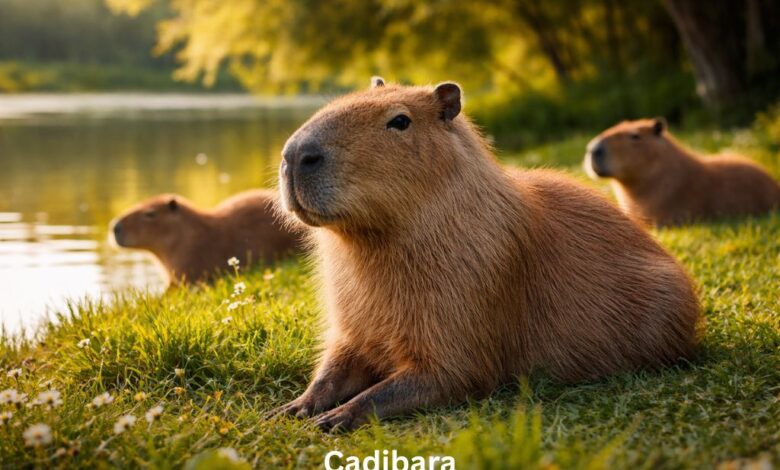
At first sight, the cadibara may appear deceptively simple. With its rounded body, short limbs, and blunt snout, it resembles an oversized guinea pig. However, this modest appearance hides a highly specialized and adaptable creature. Adult cadibaras can grow over a meter in length and weigh between 35 and 65 kilograms, placing them in a category of their own within the rodent family.
Their coarse fur, typically ranging from reddish-brown to grayish tones, provides a natural camouflage within the muddy banks and grassy wetlands they inhabit. Unlike many mammals, the cadibara lacks a tail, and its body is built low to the ground, contributing to its stability both on land and in water.
Perhaps the most distinctive feature of the cadibara is the placement of its eyes, ears, and nostrils high on its head. This adaptation allows it to remain almost entirely submerged while still being able to see, hear, and breathe—a crucial advantage in predator-rich environments.
Origins and Natural Habitat
The cadibara is native to the diverse landscapes of South America, where it inhabits countries such as Brazil, Venezuela, Colombia, Argentina, and Peru. Its preferred environments are closely tied to water. Rivers, lakes, marshes, and flooded savannas provide not only hydration but also safety and food resources.
Water is central to the cadibara’s existence. It acts as a refuge from predators, a cooling mechanism in hot climates, and a source of aquatic vegetation. During the dry season, cadibaras often gather in large numbers around remaining water bodies, forming temporary communities that highlight their inherently social nature.
These habitats are not random choices but carefully selected ecosystems that support the cadibara’s semi-aquatic lifestyle. The presence of dense vegetation nearby ensures a steady food supply, while open water provides a quick escape route when danger arises.
A Life Between Land and Water
One of the defining characteristics of the cadibara is its dual lifestyle. Equally comfortable on land and in water, it embodies a rare balance that few mammals achieve so effectively. Its partially webbed feet make it an efficient swimmer, capable of gliding through water with minimal effort.
In moments of threat, the cadibara can submerge itself almost completely, leaving only its nostrils above the surface. It can hold its breath for several minutes, a skill that often proves lifesaving when evading predators such as jaguars or caimans.
On land, the cadibara moves with a surprising agility for its size. While it may appear slow and relaxed most of the time, it can sprint quickly when necessary. However, its primary defense mechanism remains its proximity to water, reinforcing the importance of its habitat choice.
Diet and Digestive Adaptations
The cadibara is a strict herbivore, relying primarily on grasses and aquatic plants for sustenance. Its feeding habits are both simple and highly efficient. Grazing occupies a significant portion of its day, particularly during the cooler hours of morning and evening.
What sets the cadibara apart, however, is its digestive strategy. Like many herbivores that consume fibrous plant material, it practices coprophagy—the re-ingestion of its own feces. While this behavior may seem unusual, it serves a vital purpose. By passing food through its digestive system more than once, the cadibara maximizes nutrient absorption, ensuring that it extracts as much energy as possible from its diet.
Its teeth are also uniquely adapted for continuous grazing. They grow constantly throughout the animal’s life, compensating for the wear caused by chewing tough plant fibers. This ensures that the cadibara maintains its ability to feed effectively regardless of age.
Social Structure and Communication
Perhaps the most captivating aspect of the cadibara is its social nature. Unlike many rodents that lead solitary lives, cadibaras are deeply communal animals. They live in groups that can range from a handful of individuals to as many as forty, depending on environmental conditions.
These groups are typically structured around a dominant male, several females, and their offspring. Within this social framework, cooperation and communication play essential roles. Cadibaras use a variety of vocalizations—including whistles, barks, and chirps—to convey information, warn of danger, or maintain group cohesion.
Physical interaction is also a key component of their social behavior. Grooming, resting together, and synchronized movements all contribute to a sense of unity within the group. This strong social bond not only enhances survival but also contributes to the cadibara’s reputation as a peaceful and tolerant animal.
The Calm Temperament That Captivates the World
In an increasingly fast-paced and chaotic world, the cadibara has emerged as an unlikely symbol of calmness. Its relaxed demeanor, often observed as it lounges by the water or allows other animals to approach without fear, has resonated deeply with people around the globe.
This temperament is not merely a curiosity; it is a survival strategy. By maintaining a low level of aggression and fostering social harmony, cadibaras reduce internal conflict within their groups. This stability allows them to focus their energy on essential activities such as feeding, reproduction, and vigilance against predators.
Their tolerance extends beyond their own species. In the wild, cadibaras are often seen interacting peacefully with birds, monkeys, and other animals. This unique trait has contributed significantly to their growing popularity and has helped establish them as icons of coexistence.
Reproduction and Life Cycle
The reproductive cycle of the cadibara reflects its adaptability and resilience. After a gestation period of approximately five months, a female typically gives birth to a litter of one to eight offspring, with four or five being the average.
Unlike many mammals, cadibara young are relatively mature at birth. They are covered in fur, have their eyes open, and can move around within hours. Within a week, they begin to graze on grass, although they continue to nurse for several months.
Parental care is not limited to the mother. In many cases, other females within the group participate in caring for the young, a behavior known as communal parenting. This shared responsibility enhances the survival rate of the offspring and strengthens social bonds within the group.
In the wild, cadibaras typically live between seven and ten years, although they may live longer in protected environments.
Predators and Survival Challenges
Despite its size and social structure, the cadibara is not without threats. Its natural predators include jaguars, pumas, caimans, and large birds of prey. These predators rely on stealth and speed, making constant vigilance essential for cadibara survival.
Group living provides a significant advantage in this regard. With multiple individuals keeping watch, the likelihood of detecting danger early increases dramatically. Alarm calls quickly alert the group, triggering a coordinated escape toward water.
Human activity also poses challenges. Habitat destruction, hunting, and environmental changes can impact cadibara populations. However, due to their adaptability and wide distribution, they are currently classified as a species of least concern.
Ecological Importance
The cadibara plays a vital role in maintaining the balance of its ecosystem. As a primary consumer, it influences vegetation patterns through its grazing habits. By feeding on grasses and aquatic plants, it helps regulate plant growth and prevent overpopulation of certain species.
Additionally, the cadibara serves as a crucial link in the food chain. It provides sustenance for a variety of predators, supporting biodiversity within its habitat. Its presence also benefits other species indirectly, as its grazing can create pathways and open areas that facilitate movement and access to resources.
In this way, the cadibara is not just a passive inhabitant of its environment but an active contributor to its health and stability.
Cadibara and Human Interaction
Throughout history, humans have interacted with cadibaras in various ways. In some regions, they are hunted for their meat and skin, while in others, they are protected and admired as part of the natural heritage.
In recent years, the cadibara has gained international recognition, largely due to its presence on social media. Images and videos showcasing its calm behavior and unique interactions with other animals have gone viral, transforming it into a global phenomenon.
This newfound popularity has sparked interest in conservation and education, encouraging people to learn more about the species and its environment. However, it has also led to misconceptions, particularly regarding the idea of keeping cadibaras as pets.
The Reality of Keeping a Cadibara
While the idea of having a cadibara as a pet may seem appealing, the reality is far more complex. These animals have specific needs that are difficult to meet outside their natural habitat. They require access to water, ample space to roam, and the companionship of their own kind.
Without these conditions, a cadibara may experience stress, behavioral issues, and health problems. As such, they are not suitable for most households and are best appreciated in the wild or in well-managed conservation environments.
A Symbol of Balance and Simplicity
The enduring appeal of the cadibara lies not only in its physical characteristics but also in what it represents. In a world often defined by competition and urgency, the cadibara embodies a different approach—one rooted in balance, cooperation, and calmness.
Its ability to coexist peacefully with others, adapt to changing environments, and maintain a steady, unhurried pace offers a powerful reminder of the value of simplicity. It is this deeper significance that has elevated the cadibara from a regional species to a global icon.
Conclusion
The cadibara, often searched under the name “cadibara,” is a remarkable example of nature’s ingenuity. From its semi-aquatic adaptations and complex social structures to its ecological importance and cultural impact, it stands as a testament to the diversity and resilience of life on Earth.
As interest in this unique animal continues to grow, so too does the opportunity to learn from it. Whether observed in the wild or admired from afar, the cadibara invites us to reconsider our relationship with nature—and perhaps, to embrace a little more calm in our own lives.